

Retreading

The primary activity of our company is retreading tires because it has proven to be an efficient and economical way to reuse old tires.
What is retreading?
Retreading is a technology that makes used tires reusable by replacing a worn and damaged outer layer with a new layer of rubber. The load-bearing structure of a tire is usually much more durable than the tread, so this is the main reason why retreading has been developed as a method of tire renewal process. If the load-bearing structure is preserved, instead of throwing away the rubber, it can be retreaded and reused.
Liprad catalog
Quality guarantee
Liprad d.o.o. has know-how in the so-called cold retreading process. Main features of this process are high safety and economic profitability. It is important to mention the environmental aspect of retreading, especially when we talk about extremely high loads on truck, bus and industrial tires.
The ECE 109 E1 certificate (E1 mark stands for Germany), issued by an independent laboratory in Germany, guarantees the quality of our tires and enables export to the EU.
We nurture long-term business partnerships with customers and suppliers, which are based on trust and quality. Liprad products are marked by practical experience related to the world’s leading treads.
RINGTREADING VS RETREADING
Each ring is produced individually by means of a centripetal radial press. Therefore, vulcanisation takes place in the final configuration of the tread, allowing the molecular structure to stabilise in a stress-free configuration.
no deformation = less wear
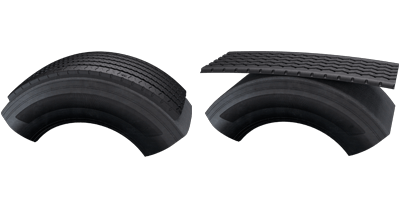
The strips are produced in long multi-stage presses, where it is difficult to precisely check temperature, pressure and vulcanisation times. The strip does not follow the convex shape of the casing: this deformation generates tension between the tread and the structure of the tyre, causing overheating.
The convex profile of the ring perfectly adapts to the curvature of the casing, preserving its integrity. Surface uniformity ensures maximum adhesion between the tread and the tyre structure as well as superior performance.
uniform tread = more kilometres
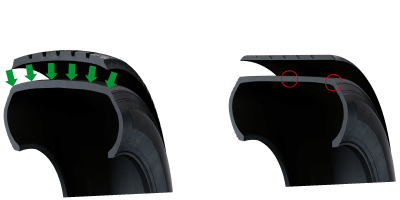
The application of a flat strip to the convex shape of the tyre structure causes deformation and weak points, which increase the tread wear rate and cause the casing to overheat, which could reduce the life of the tyre.
RINGTREAD allows for perfectly balanced retreaded tyres. The fact that they are spliceless reduces rolling resistance and ensures slow and regular wear, thus significantly reducing mileage costs and the total price of owning the tyre.
spliceless = maximum reliability
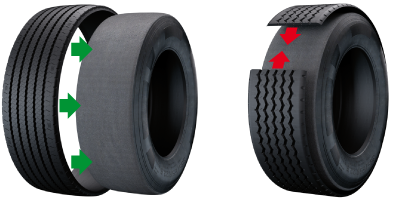
Retreading using conventional flat strips necessarily involves the presence of at least one splice. In addition to inevitably throwing the tyre off balance, this creates a weak point that can increase the likelihood of the thread detaching itself.
We have been retreding tires for more than 25 years
If you have any questions regarding tire retreading, please contact us without hesitation. We are here to find the best and most favorable solution for you.
Large selection of draft
We cooperate with renowned companies in the production of Marangoni Retreading Systems Deutschland and set high quality and service requirements for our tires.

There is nothing that MARANGONI Retreading Systems Deutschland GmbH cannot provide as a solution in tire retreading.
Our philosophy is “All from one source”, which means we are looking for a close partnership with our customers. This refers to the production and distribution of all materials for hot and cold retreading, as well as the selection of suitable machines, planning and optimization of the production flow, the complete production line until the installation and commissioning of the plant.
Technical or economic advice / consulting – the list of activities in which we can offer our expert opinion and knowledge is long and growing daily. At the link below you can see our product line to see for yourself the quality.

Environmentally friendly production methods
Like our foreign partners, we apply the most modern production methods in production and our primary goal is environmental protection.
Application of the latest technological solutions
Our retreading facility applies modern technological solutions adapted to the cold retreading method.
Use of quality materials
When retreading tires, we use the highest quality treads from Marangoni (Germany).
Quality guarantee
The ECE 109 E1 certificate (E1 mark stands for Germany), issued by an independent laboratory in Germany, guarantees the quality of our tires and enables export to the EU.
Satisfaction of our clients
25 years of successful business and international cooperation have led to a daily increase in the number of satisfied customers.
The retreading process
Each retreading begins with a visual inspection of the tire. If damage is found, it is repaired or such a tire is thrown away. If there is a possibility of repair, then the remaining material of the tread is removed on a special machine, almost to the carcass (wire). The sanded rubber is inspected again and if it passes this control, it goes to the gluing of a new tread. The sanded surface is first coated with a special glue, and then a thin strip of binder rubber and a new tread are applied to it. The tire is then placed in a special rubber casing from which air is extracted to create a vacuum that allows the two tire bodies to connect better. The gluing itself is performed in a pressure chamber, in a kiln, where the tires remain for several hours to vulcanize. At the end of the procedure, the tires are removed and placed to cool, making sure that they are laid flat on a flat surface.
As a rule, the retreaded tire must not be older than 5 years. The retreaded tire is not used on the front end, ie on the steering axle. Other characteristics of retreaded tires are the same as for new tires (load capacity, maximum permissible speed, etc.). The retreaded tire must be marked with a tread mark on the side. The advantages of retreading are the following:
Security
ensured by high and uniform quality, reliability, durability and resistance to damage.
Economy
because they achieve the same mileage as new tires, and at the same time reduce the cost of purchasing tires by about 30%.
Environmental protection
because with a new service life, retreaded tires preserve the natural resources and energy used in the manufacture of tires.